


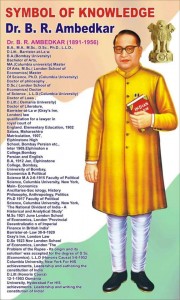
The symbol of knowledge: Dr.B.R. Ambedkar
BhimraoRamjiAmbedkar (14 April 1891 – 6 December 1956), popularly known as Babasaheb, was an Indian jurist, economist,politician and social reformer who inspired the Dalit Buddhist Movement and campaigned against social discrimination against Untouchables(Dalits), while also supporting the rights of women and labour. He was Independent India’s first law minister and the principal architect of the Constitution of India.
Ambedkar was a prolific student, earning doctorates in economics from both Columbia University and the London School of Economics, and gained a reputation as a scholar for his research in law, economics and political science. In his early career he was an economist, professor, and lawyer. His later life was marked by his political activities; he became involved in campaigning and negotiations for India’s independence, publishing journals advocating political rights and social freedom for Dalits, and contributing significantly to the establishment of the state of India. In 1956 he converted to Buddhism, initiating mass conversions of Dalits.
In 1990, the Bharat Ratna, India’s highest civilian award, was posthumously conferred upon Dr.Ambedkar.
Various Books written by Baba Saheb:
- Castes in India: Their Mechanism, Genesis and Development and 11 Other Essays
- Ambedkar in the Bombay Legislature, with the Simon Commission and at the Round Table Conferences, 1927–1939
- Philosophy of Hinduism; India and the Pre-requisites of Communism; Revolution and Counter-revolution; Buddha or Karl Marx
- Riddles in Hinduism
- Essays on Untouchables and Untouchability
- The Evolution of Provincial Finance in British India
- The Untouchables Who Were They And Why They Became Untouchables ?
- The Annihilation of Caste (1936)
- Pakistan or the Partition of India
- What Congress and Gandhi have done to the Untouchables; Mr. Gandhi and the Emancipation of the Untouchables
- Ambedkar as member of the Governor General’s Executive Council, 1942–46
- The Buddha and his Dhamma
- Unpublished Writings; Ancient Indian Commerce; Notes on laws; Waiting for a Visa ; Miscellaneous notes, etc.
- Ambedkar as the principal architect of the Constitution of India
- (2 parts) Dr.Ambedkar and The Hindu Code Bill
- Ambedkar as Free India’s First Law Minister and Member of Opposition in Indian Parliament (1947–1956)
- The Pali Grammar
- Ambedkar and his Egalitarian Revolution – Struggle for Human Rights. Events starting from March 1927 to 17 November 1956 in the chronological order; Ambedkar and his Egalitarian Revolution – Socio-political and religious activities. Events starting from November 1929 to 8 May 1956 in the chronological order; Ambedkar and his Egalitarian Revolution – Speeches. (Events starting from 1 January to 20 November 1956 in the chronological order.)
- Ambedkar’s Speeches and writing in Marathi
- Ambedkar’s Photo Album and Correspondence
- Administration and Finance of the East India Company
- The Evolution of Provincial Finance in British India
- The Problem of the Rupee: Its Origin and Its Solution